
Product Guide
What 'sticky icky' actually means — flower quality, plain English
The phrase is older than half our customers. Here's what flower-shop pros mean when they say it — and why it's a quality signal, not a slang flex.
People say "sticky icky" like it's just slang. It's not. It's the oldest plain-language quality check in the cannabis world — and it tells you something specific about the flower in your jar.
Where the phrase comes from
The phrase entered hip-hop vocabulary through Snoop Dogg in the early 2000s, but the term predates him by decades. Old-school growers and connoisseurs called premium flower "sticky" because high-quality cannabis is, literally, sticky to the touch.
The "icky" half is harder to source. Best guess: it's onomatopoeic. The sound of pulling apart resinous bud — a faint ick as the trichomes resist before they let go.
What matters more than the etymology is what the phrase means in practice: a tactile and visual quality check that requires no lab report and no instrument. You can verify "sticky icky" with your fingers in five seconds.
Why it's actually a quality signal
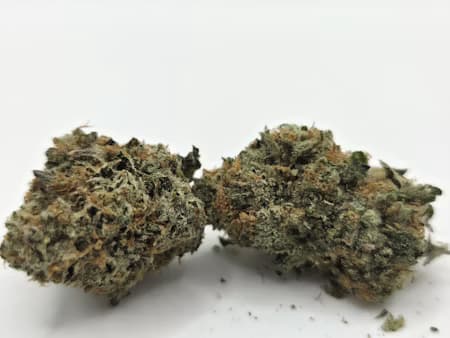
The stickiness you feel on a quality nug isn't moisture. It's trichome resin — the microscopic crystal-coated glands on the surface of the flower that produce nearly all of the plant's cannabinoids (THC, CBD, CBG, CBC) and terpenes (the aromatic compounds that give each strain its flavor and effect profile).
Trichomes are visible to the naked eye as the frosted, crystal-like coating on top-shelf flower. Under a jeweler's loupe or macro lens, you can see them as tiny mushroom-shaped glands. The "head" of each trichome is where the cannabinoids and terpenes are concentrated.
When you press a properly cured, well-grown bud between your fingers, two things happen:
- It compresses but doesn't crumble. That's the right moisture level — around 10–12% relative water content.
- Your fingertips feel tacky, like fresh pine sap or honey. That's the trichome resin transferring from the bud to your skin.
If a nug crumbles to powder in your fingers, it was over-dried or it's old. If it's wet enough to leave water on your fingers, it's improperly cured and you risk mold. Sticky-icky lives in the middle, and it's what every grower aims for.
The curing process — why it matters
Sticky-icky doesn't happen by accident. It's the result of a multi-week curing process that turns harvested cannabis into shelf-stable, terpene-rich flower. The short version:
- Cut and trim — fresh harvest, leaves removed
- Dry — hang for 7–10 days in a controlled environment until the moisture drops from ~75% to ~12%
- Cure — sealed in jars (or industrial equivalent) for 2 to 6 weeks, with daily "burping" (briefly opening) to release trapped moisture and prevent mold
- Final pack — into the jar or pouch you eventually buy
Improperly cured flower is the most common quality failure in commercial cannabis. Rush the cure and you get harsh smoke, lost terpenes, and a hay-like smell. Cure too long without burping and you grow mold. Skip the cure entirely and you get the brick-weed of the 1990s.
A properly cured top-shelf flower is what "sticky icky" describes. It's the goal post.
What to look for in person
When you open a jar from Raindrops, here's the five-second quality check:
- Visible trichome coverage. Crystal-frosted edges. Sometimes a faint amber sheen on older, more mature trichomes — those carry the heaviest cannabinoid load.
- A slight tug when you separate two buds. They want to stick to each other, which is the resin doing its job.
- Aroma. Top-shelf flower smells like itself — not like hay, not like nothing. The terpene profile should be obvious within a few inches of the open jar. Diesel strains smell like diesel. Cookie strains smell like baked dough. Fruit strains smell like fruit.
- Springy compression. Press a bud lightly. It bounces back, doesn't pancake into compressed material.
- Sticky scissors. When you grind, the scissors come out tacky. That tackiness is the trichomes coating the metal.
- Color depth. Quality flower has visible color variation — greens, purples, oranges from the pistils (the hairy strands). Flat-color brown flower is usually over-dried or old.
If a jar fails three or more of these, the flower wasn't cured right or it's been on a shelf too long. If it passes all six, you're holding top-shelf material.
What "sticky icky" doesn't mean
A few misconceptions worth clearing up:
It doesn't mean wet. Wet flower is over-cured or mold-risky. Sticky is tacky, not damp. If your fingers leave a wet print, that's bad.
It doesn't mean strong by itself. THC% is a separate variable. You can have a properly cured 18% flower that's perfectly sticky-icky and a 28% flower that's been on a shelf too long and gone dry. Stickiness signals quality of cure, not strength.
It doesn't mean expensive. Some of our Under $25 picks hit the sticky-icky bar. Price tracks rarity and brand reputation more than it tracks cure quality.
It's not the only quality signal. Terpene profile, strain genetics, and freshness all matter too. But sticky-icky is the easiest signal to verify in five seconds without a lab.
How to store flower so it stays sticky
If you bought top-shelf and want it to stay top-shelf:
- Glass jar with a tight seal. Original packaging works; mason jars also work. Plastic bags are fine short-term but leach terpenes over time.
- Humidity pack — Boveda or Integra packs in the 58% or 62% RH range keep flower at the moisture sweet spot. Drop one in the jar and forget it.
- Dark storage — UV light degrades cannabinoids and terpenes. A drawer or cabinet beats a windowsill.
- Cool, not cold — room temperature is fine. The fridge isn't necessary and the freezer can damage trichomes.
Flower stored this way holds quality for 6+ months. Flower in a plastic bag on a sunny shelf goes flat in 4–6 weeks.
What to do if your flower goes dry
It happens — you forgot the humidity pack, or the jar wasn't sealed tight, or you found an old stash. A dry-but-otherwise-okay flower can be partially rehydrated:
- Drop a humidity pack in the jar and seal it for 24 hours
- A small piece of fresh orange peel works in a pinch (don't leave it long — fruit grows mold fast)
- A wet cotton ball in a separate compartment of the jar can add humidity slowly
Don't try to rehydrate over-dried flower with water sprays. You'll either fail to penetrate the buds or you'll create surface moisture that triggers mold.
If the flower has lost its smell entirely, it's lost most of its terpenes — rehydration won't fix that. Use it for cooking infusions or move on.
Why we use the phrase on our website
We carry flower we'd order ourselves. The "Sticky · Icky" pill in our hero isn't marketing — it's the spec we use when we decide what goes on the menu. If a strain doesn't pass the resin test, it doesn't get listed.
Everything in the Flower category on our menu is selected for trichome density and proper cure. That's why we put it in the headline. And the ✦ STICKY badge on individual product cards marks our premium tier — the $40-and-up flower and high-dose edibles — within that already-curated selection.
Common questions
Is sticky-icky the same as "fire" or "exotic"? Roughly, yes. "Fire" is the modern term for what old-school growers called "sticky icky" — premium, well-cured, terpene-rich flower. "Exotic" usually adds genetic rarity to the mix.
Can pre-rolls be sticky-icky? Yes, if the flower inside them is. The cone format hides the visual check, but a sticky-icky pre-roll feels slightly heavier and more dense than a trim-based one, and the smoke is smoother.
Do edibles have a sticky-icky equivalent? The equivalent is "full-spectrum" vs "distillate." Full-spectrum edibles preserve the original terpene and minor cannabinoid profile of the source flower. Distillate-based edibles use a stripped-down isolate. Both can be high quality; full-spectrum tends to feel more nuanced.
Why do some dispensaries sell crumbly flower? Cost. Properly cured top-shelf flower takes 4–8 weeks longer to produce than rushed flower. The shelf-life and consumer experience are dramatically better, but the upfront cost is higher.
Try it yourself
- Browse Flower — every product on our menu passes the sticky-icky bar
- Take the strain finder quiz — we'll match you with a sticky-icky pick based on how you want to feel
- Flower, Pre-Rolls, or Edibles? — choosing the right format
21+ only. Free delivery on orders over $25. Tax-free. Same-day across Manhattan, Williamsburg, Greenpoint, and Long Island City.
Continue reading
More from the journal.
Delivery
Brooklyn and Queens cannabis delivery in 50 minutes — how the routing works
Our delivery window to Brooklyn (Williamsburg, Greenpoint) and Queens (Long Island City) averages 50–55 minutes door-to-door. Here's why that's hard, how the routing works, and what to expect at the door.
Read articleEducation
Flower, Pre-Rolls, or Edibles: How to choose the right format
A plain-English guide to the three product categories on the Raindrops menu — when to choose each, how to read labels, and what new customers get wrong most often.
Read article
Ordering
How checkout works at Raindrops Greenery — step by step
Exactly what to expect from menu browse to order placed to delivery confirmed. No surprise fees, no upsells, no friction.
Read article